
Texas Hold'em Rules: How to Play in One Page
Texas Hold'em uses a standard 52-card deck (no jokers). In CC Poker, tables are 2, 6, or 9 players. Each player gets two private hole cards and shares up to five community cards. The best five-card hand wins — or the last player left when everyone else folds. Below is the flow of one hand.
Basics
- Button (dealer): Moves one seat clockwise after each hand. It sets who posts blinds and who acts last after the flop. See the position guide.
- Blinds: The seat left of the button posts the small blind; the next seat posts the big blind (usually twice the small blind). Blinds force chips into the pot before cards are dealt.
- Hole cards & board: Two hole cards are private. Up to five community cards are shared.
- Pot: All chips put in during the hand. The best remaining hand wins it, or the last player standing takes it without showdown.
How one hand plays out
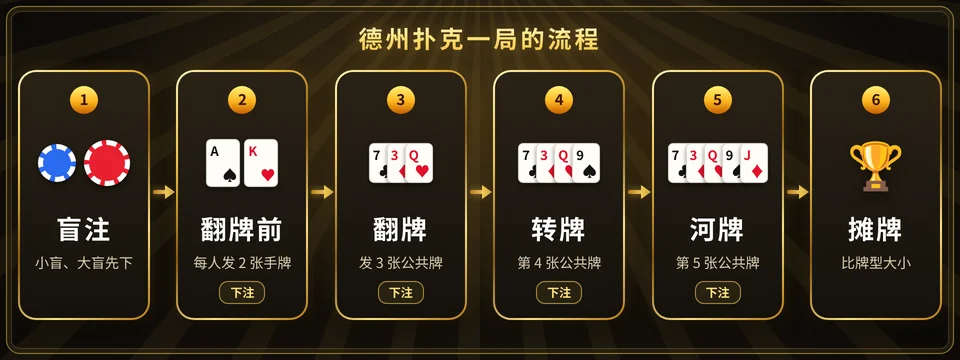
1. Post blinds and deal hole cards
After blinds are posted, each player receives two hole cards.
2. Preflop
Action starts with the player left of the big blind and moves clockwise. Options: fold, call, or raise. The big blind acts last preflop.
3. Flop
Three community cards are dealt at once. A new betting round starts with the first active player left of the button.
4. Turn
A fourth community card is dealt, then another betting round.
5. River
A fifth community card is dealt, then the final betting round.
6. Showdown
If two or more players remain, hands are shown. The best five-card combination wins the pot.
Heads-up note: the button posts the small blind and acts first preflop, then last on later streets.
Betting actions
| Action | When | Meaning |
|---|---|---|
| Check | No bet yet this street | Pass the action without putting in chips |
| Bet | No bet yet this street | First chips into the pot this round |
| Call | Facing a bet | Match the current amount |
| Raise | Facing a bet | Increase the current amount (no-limit: min raise is usually at least the previous bet/raise size) |
| Fold | Your turn | Give up the hand; chips already in stay in the pot |
| All-in | Your turn | Put in all remaining chips |
A betting round ends when every active player has matched the same amount (or is all-in). The first bet on a street is typically at least one big blind.
All-in and side pots (short version)
If you cannot cover a bet, you may go all-in. You can only win the main pot up to what you put in. Extra chips between other players form a side pot you do not contest.
Example: A is all-in for 1,000; B and C put in 3,000 each. Main pot = 3,000 (A, B, C). Side pot = 4,000 (B vs C only).
Full worked examples: all-in and side pots.
Showdown
- Each player makes the best five-card hand from their two hole cards plus the five board cards (using 0, 1, or 2 hole cards).
- Compare hand categories first, then kickers. Suits do not break ties.
- Identical five-card hands split the pot.
Hand rankings (high to low)
Full table with examples: Texas Hold'em hand rankings.
- Royal flush
- Straight flush
- Four of a kind
- Full house
- Flush
- Straight
- Three of a kind
- Two pair
- One pair
- High card
Deeper rules pages
- Blinds & button — who posts SB/BB, who acts first, heads-up blinds, antes.
- Dealing & burn cards — shuffle, cut, hole cards, burns, flop/turn/river.
- Table size & heads-up — 2/6/9 seats, cards used, heads-up blinds and action order.
- Straddle — voluntary extra blind before the deal, who acts, variants.
- Betting actions — check, bet, call, raise, fold, all-in, min-raise, showdown order.
- All-in & side pots — main pot, side pot, refunds, worked examples.
- Hand rankings — ten categories with examples.
After the rules
Read the learn hub, then try a private room with friends. Practice tables use entertainment chips only.